


When you think about commercial trapping in Canada, do you picture wolverines?
We didn’t.
It was pretty shocking to find these elusive carnivores appearing in Canada's most recent commercial fur production records alongside grizzly bears and even polar bears. It's not so much the numbers themselves that are disturbing, but what these animals represent and the fact that species many Canadians associate with conservation and recovery efforts are still entering commercial markets.
These are the species we feature in documentaries, celebrate in photography, and rally around in conservation campaigns. They're not the animals most people would expect to find in a commercial fur production report, especially given their designations.
Thanks to climate-related habitat loss, increasing threats from industrial development and risks to population stability, wolverines face a complex set of challenges. Listed as Endangered in Eastern Canada, they occur at such low densities across much of their range that they remain one of the country's most difficult carnivores to study and, in turn, protect. Because wolverines occur at naturally low densities and reproduce slowly, a small harvest can still be significant depending on the population and where those animals were taken. Grizzly bears are federally listed as a species of Special Concern under COSEWIC. Among the slowest reproducing land mammals, grizzlies continue to be the focus of recovery efforts, with areas such as Yoho, Glacier and Jasper National Parks acting as mortality sinks for this important keystone species.
It’s worth noting the gravity of these designations. To put it simply, species listed as Special Concern could become Threatened or Endangered if actions are not taken to reduce threats to the species. So, why are species of special concern still appearing in commercial trapping records?
It’s a question we should all be asking, but answering it means looking beyond the harvest numbers themselves and asking whether the systems used to manage commercial trapping are transparent enough, adaptive enough, and informed by the best available science to justify claims of sustainability.
When we originally set out to better understand the scale of Canada's commercial trapping industry, we thought we were asking relatively straightforward questions. How many wild animals are trapped commercially each year? Which species are most affected? Has that changed over time? But as is often the case in this line of work, the deeper we looked, the more questions emerged along with a rather frustrating one: if this information already exists, why is it so hard to find?
Thankfully, we have Madeline, who spent weeks diligently pulling the pieces together so we could begin to see the full picture.
One of the biggest challenges in understanding trapping in Canada is that there is no single, centralized public database showing how many animals are trapped each year, where trapping pressure is concentrated, or how harvest numbers have changed over time. Instead, information is collected through a combination of sources, including provincial wildlife agencies, export records, compulsory trapper reports, pelt inspection programs, auction markets, and summaries produced by organizations such as the Fur Institute of Canada.
Annual fur production tables compiled by the Fur Institute of Canada offer information submitted by provincial wildlife managers, biologists, trappers, and fur dealers. These figures provide an indication of the scale of commercial fur production in Canada, particularly because most commercially harvested furbearers enter regulated markets, but these records have limitations. The available data primarily tracks animals whose pelts enter commercial markets, but might not capture animals that are trapped and never sold, pelts that are damaged or discarded, animals used locally, or harvests that are not reported through official systems. Even understanding long-term trends is challenging, as archives for Statistics Canada datasets tracking pelt production end at 2011.
We believe Canadians should have the ability to participate in conversations around wildlife management with a clear understanding of what is actually happening on the landscape. That shouldn't be controversial, yet despite the amount of information collected by governments and industry, significant gaps remain in what is easily accessible to the public.
The records we accessed provide just a snapshot of commercial production rather than a complete picture of wildlife mortality, population health or the many factors influencing management decisions. Those are conversations that deserve continued research, open discussion and ongoing public engagement.
What the available records do reveal is that commercial trapping remains widespread across Canada, and the numbers challenge a fairly common assumption that trapping is limited to a relatively small group of furbearers with abundant, healthy and stable populations.
During the 2023-24 season, 330,710 wild animal pelts were recorded nationally, including more than 88,000 beavers, over 60,000 martens, 49,000 muskrats, and more than 36,000 coyotes.
Alongside those species were 5,594 Canada lynx, 2,861 wolves, 1,581 black bears, 1,092 bobcats, 486 wolverines, 57 grizzly bears, 46 cougars, and five polar bears.
The most commonly recorded species entering commercial markets nationally according to Fur Institute of Canada’s 2023–24 fur production data:
Additional species recorded included:
That is a substantial amount of wildlife leaving our ecosystems. If we are to accept these quotas, then we must question whether the benefit of commercial trapping outweighs the detriment to ecosystems, their services and the wildlife populations required to sustain them.
So what is a pelt worth? According to The Fur Harvesters listing, in 2025 the average price for a squirrel pelt was just $1.27 USD and a wolverine, $459.20 USD. When you consider the ecological value of the animals on that list compared to the prices fetched for their pelts, it’s hard to comprehend where the economic value really sits.
The unsettling reality is that unsold pelts are disposed of. In 2023, the Fur Harvesters Auction’s first bi-annual auction offered 45,440 coyote pelts for sale, with just 27,264 being sold. The second auction offered 41,855 pelts for sale, with 10,045 pelts being sold. The result was 49,986 coyote pelts being unsold in 2023. That equates to almost 50,000 coyotes being killed for their fur, just to have it thrown away. Although the numbers vary for each furbearer, the fact is that they are being killed unnecessarily by the thousands to fulfil arbitrary quotas. We hope you were sitting down for that.
It’s not widely known that commercial trapping is still being subsidized by the government with taxpayer dollars. Federal records show millions distributed to various fur and trapping operations to support the sector, and some regional jurisdictions offer economic relief for trapline operators, such as specific off-road fuel tax exemptions for active concession management. According to data from the Government of Canada, between the years of 2015 and 2019, nearly $11.5 million in payments were provided to various fur and trapping operations, along with $9.2 million in grants and subsidies to the fur industry within Canada.
In modern society, it is rare for trapping profits to be economically sustainable for a trapper. In just ten years, there was an 85% reduction in the value of pelts produced/sold in Canada, with revenue down to $7.8 million in 2022. This drastic drop was a reflection of consumer preferences and an industry out of step with modern ethics.
In 2018, it was estimated that commercial trapping generated $91 million toward Canada’s GDP and supported 738 jobs.
To put this into perspective, in British Columbia alone, the tourism industry contributes $22.3 billion into the economy annually and supports 19,300 businesses that employ over 320,000 workers. Narrowing that down further, the Adventure Tourism industry in BC is worth over $3.2 billion in direct visitor spending and supports over 32,000 families in communities across the province. The social benefits to BC communities from eco-tourism include improved health and well-being, educational opportunities, environmental stewardship, improved backcountry access, and enhanced emergency response. Another comparable non-consumptive industry in Canada is photography, which generated $1.3 billion in revenue, employed 12,567 Canadians, and supported 8,426 businesses in 2023.
If commercial trapping remains a fringe industry, it’s hard to understand why governments are not only propping it up, but why they are dedicating trapper access to protected land that could be used to support conservation or economically sustainable and non-consumptive industries. It’s worth noting that sustainable industries such as eco-tourism or professionals working in wildlife photography are not permitted to purchase the land.

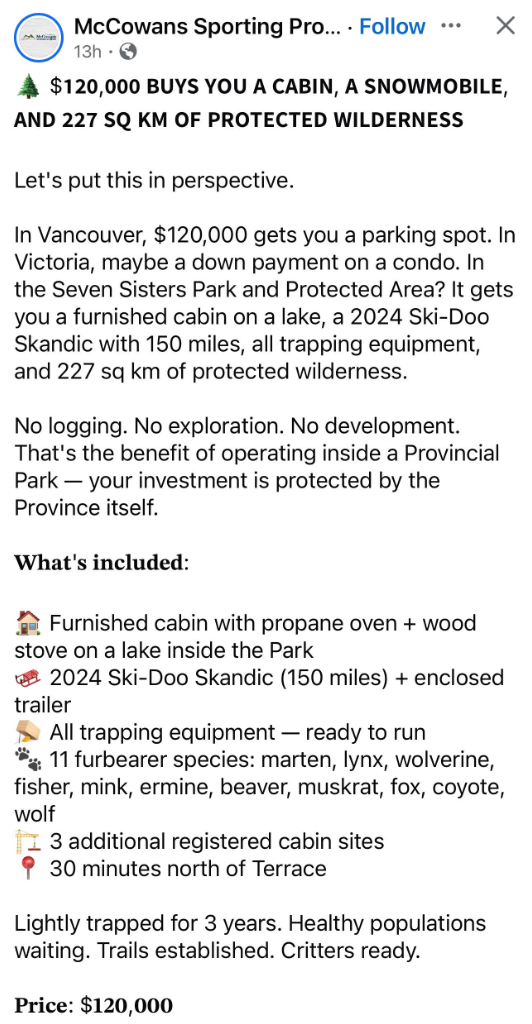
Aside from the questions circling the economic benefits of trapping, what none of the numbers actually tell us is whether current management approaches or commercial trapping are, in fact, sustainable.
A central narrative of the industry is that trapping is inherently sustainable because it is regulated, and at first glance, that sounds relatively reasonable. The not-so-clean-cut reality is that sustainability is far more complex than simply setting harvest limits. It depends on the quality of population data, the health of ecosystems, cumulative pressures on wildlife, effective monitoring, and a willingness to adapt management as conditions change. For wide-ranging predators already facing the impacts of habitat loss, climate change, and industrial development, those pressures do not exist in isolation.
It also isn't something that can be assessed at a national level. Every province manages trapping through its own legislation, reporting requirements, monitoring systems, and population objectives. A species that is considered secure in one region may be under very different pressures in another, meaning the question of sustainability has to be understood within the local ecological context.
In the Prairie provinces, for example, trapping records are largely dominated by species such as coyotes, beavers, and muskrats. Further north, across Canada's boreal forests, species including marten, lynx, fisher, and wolverine become more prominent. In Atlantic Canada, beavers, muskrats, foxes, and coyotes make up a larger portion of recorded harvests.
These regional differences matter because national production figures can only ever tell us part of the story. They show how many pelts entered commercial markets, but they cannot explain the ecological context, population trends, impact or management decisions behind those numbers.
To understand what this looks like in practice, we took a closer look at Alberta and British Columbia. Both provinces collect significant amounts of trapping data through detailed monitoring systems. Yet each illustrates how difficult it can be for the public to follow changes in wildlife management over time because much of that information never makes its way into publicly accessible summaries.
In 2024, Alberta’s Minister of Forestry and Parks, Todd Loewen, removed furbearer trapping limits, providing a devastating example of how quickly the picture can change and why it’s critical that the full spectrum of data is publicly available for assessment along with meaningful and inclusive consultation.
Today in Alberta, publicly available information comes primarily from annual fur production summaries based on export permits rather than direct trapline harvest counts, making it more difficult to understand local patterns of trapping activity or compare changes over time.
What the available records show is that Alberta’s commercial fur trade is not static. During the 2023-24 season, coyotes remained the most commonly recorded species entering commercial markets, with 11,786 pelts reported, followed by 8,264 beavers, 6,054 martens, 5,003 squirrels, 2,633 muskrats, 2,378 weasels and ermine, 1,213 Canada lynx, and 931 foxes.
Comparing those numbers with previous years reveals some significant shifts. Coyote harvests declined from 29,148 in 2020-21 to 11,786 in 2023-24. Muskrat harvests decreased from 10,328 to 2,633 over the same period, while foxes declined from 1,748 to 931. Increases were seen with marten harvests rising from 3,828 to 6,054, beavers increased from 6,222 to 8,264, and squirrels saw an increase from 3,829 to 5,003.
The reasons behind these changes are not always clear. Wildlife populations, market conditions, environmental changes, trapper participation, and management decisions can all influence annual harvest numbers. Without access to the broader datasets behind these summaries, it is difficult for the public to fully understand what is driving these trends and, in turn, advocate for protections where needed.
Things are a little different in British Columbia. The province has one of the more structured trapping management systems in Canada, with registered traplines, annual reporting requirements, compulsory inspections for some species, mandatory harvest reporting, species-specific management plans, and quotas in certain regions.
During the 2023-24 season, beavers and martens represented the largest number of recorded pelts in British Columbia, with 6,946 beavers and 6,006 martens entering commercial markets. Other recorded species included 1,926 squirrels, 1,741 weasels and ermine, 743 coyotes, and 499 Canada lynx. Additional records included 45 black bears, 145 wolverines, and 301 wolves.
BC also appears to maintain extensive internal records, including trapline harvest returns, geographic harvest zones, pelt inspection records, harvest effort metrics, and species-specific annual totals. These records can provide valuable insight into how wildlife harvest is changing across the province, but unfortunately, much of that information is not easily accessible for the public to explore.
Together, Alberta and BC illustrate a broader challenge facing wildlife management across Canada. Understanding populations, tracking trends, and making responsible decisions all require detailed data. The challenge is making that information accessible enough that researchers, communities, and the public can engage with the decisions being made about wildlife.
Without awareness and the ability to take action, the public is forced to rely on the overstretched agencies tasked with oversight and enforcement of commercial trapping regulations. In 2013, BC had just 87 Conservation Officers responsible for monitoring approximately 944,735 square kilometres of land. Earlier this year, EWC presented recommendations to the BC standing committee for increased investment in the COS and for good reason. With so few officers, equipment deficits and mounting challenges, their capacity to enforce regulations is increasingly limited.
Trapping exists within a complicated regulatory landscape. Commercial trapping in Canada is primarily managed at the provincial and territorial level, meaning there is no single approach that applies across the country. Each jurisdiction determines its own licensing requirements, reporting systems, species management strategies, and enforcement frameworks.
At the national level, coordination occurs through organizations such as the Canadian Furbearer Management Committee and trade agreements like the Agreement on International Humane Trapping Standards (AIHTS).
In 1991, the European Union passed a regulation banning the import of wild fur from specific animal species caught using inhumane methods like standard leghold traps, threatening a complete trade embargo on wild fur exports from Canada.
Essentially, the AIHTS was born out of trade rather than conservation. To maintain access to the lucrative European wild fur market. Canada, the EU, and Russia negotiated and signed the AIHTS in December 1997 (with the U.S. signing a parallel "Agreed Minute"). It established internationally recognized standards for trapping methods of 19 species of furbearing mammals and came into force in Canada in 1999.
For many within the commercial trapping industry, frameworks such as the AIHTS are presented as evidence that commercial trapping is humane, sustainable and science-based. Others argue that meeting minimum trap standards says very little about the broader questions of animal welfare, ecological sustainability, cumulative impacts on wildlife populations, or whether management reflects modern conservation values.
Conversations often centre around issues such as trap design, non-target captures, reporting requirements, and how frequently traps must be checked. For example, regulations in some provinces continue to allow certain live-holding traps to remain unchecked for extended periods. Manitoba regulations allow some live-holding traps to be checked every 72 hours, raising questions among wildlife advocates about whether those timelines align with evolving expectations around animal welfare.
These discussions are reflective of a broader shift in how many people think about wildlife management. As our understanding of animal behaviour, ecological relationships, and the importance of healthy predator populations continues to grow, so too does the public conversation about how wildlife should be managed in modern Canada.
While public opinion alone cannot determine wildlife management decisions, attitudes toward fur and wildlife management have shifted over time, and Canadians are thinking differently about their relationship with wildlife than they may have a generation ago; that shift makes transparency even more important. Recent polling conducted by Research Co. found that 78% of Canadians oppose killing animals for fur in 2025, compared with 77% in 2023. The same research found that 74% of Canadians support banning fur farming in Canada.
Conversations about trapping often become polarized before people have had the opportunity to understand how the system actually works. Wildlife management will always involve competing values, difficult trade-offs and complex ecological realities, but good conversations depend on good information.
Access to clear, consistent information is the foundation of more informed discussions about wildlife policy, conservation priorities, and the role trapping continues to play in Canada's culture and economy.
Data scattered across reports, agencies and jurisdictions makes it difficult for researchers, journalists, conservation organizations and the public to ask informed questions about how wildlife is being managed and why certain decisions are made.
Whether you are someone who depends on trapping for your livelihood, or someone who believes it has no place in modern conservation, one thing we hope we can all agree on is that information should be accessible.
We believe that if commercial trapping is to continue under the banner of sustainable wildlife management, then demonstrating sustainability should be an ongoing responsibility, not an assumption or assertion. That requires transparent data, current wildlife science, meaningful public accountability, and management frameworks that evolve alongside our understanding of wildlife, ecosystems, and animal welfare.
Finding species of special concern in a table of commercial fur production should make us curious enough to ask more questions and bold enough to demand transparency, because the future of these important species depends on our ability to understand, inform and challenge those decisions. Better questions lead to better conversations, and better conversations lead to better wildlife policy.
You can support our work in advocating for transparency, access to information and improvements to commercial trapping standards with a donation, or by adding your name to the petition. We are urging BC’s government to update trapping regulations in support of stronger protections for wildlife, pets and the public.
