


The story of climate change is often told through rising seas, melting glaciers, droughts, floods and wildfires. But there is another story that has been unfolding closer to home for some time: the loss of Canada’s wildlife.
The recently released WWF Living Planet Report Canada 2025 paints a stark picture: wildlife populations across the country have declined by an average of 34% since 1970, with species in boreal and mountain regions facing some of the steepest losses. Climate change accelerates this decline by reshaping habitats faster than ecosystems can adapt. Coupled with resource extraction, increased hunting quotas and human-caused habitat destruction, wildlife is struggling to find a foothold.
Apex predators represent an important intersection in our approach to this changing world. Their survival is not only a measure of ecological health; it is also a reflection of how we choose to recognize the need for a shift in our approach from ‘wildlife management’ to responsible stewardship. This is a necessary pivot if we are to confront the very real and immediate crises of climate change and biodiversity loss.
According to the IPBES Global Assessment, one million species are now at risk of extinction, and Canada is experiencing biodiversity loss at a faster rate than the global average in several ecosystems due to climate pressures and habitat fragmentation.
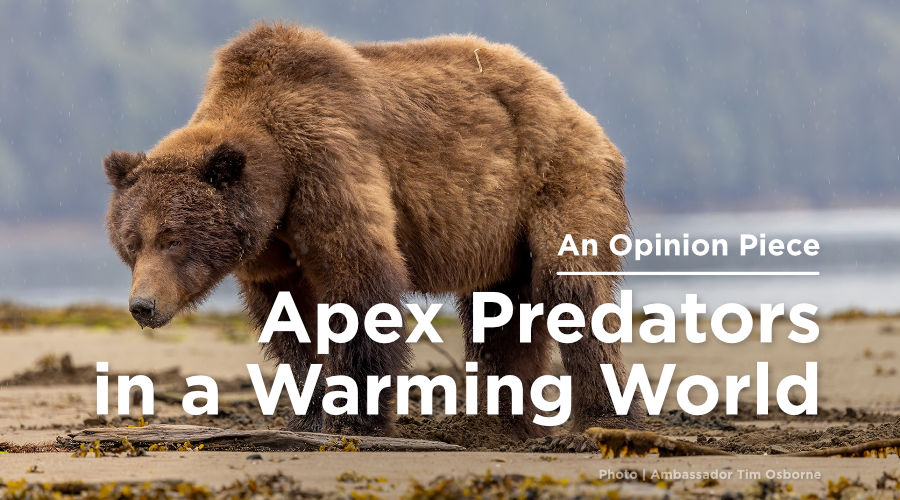
Warmer winters are already disrupting the natural rhythms that wildlife rely on. Grizzlies are resilient and adaptable, but they are not immune to the impacts of a rapidly changing climate. Rising temperatures and shrinking snowpacks can trigger bears to leave their dens early, extending the window for potential conflict with humans. When droughts alter ponds, lakes and river systems, prey animals migrate in unpredictable ways, disrupting the behaviour of wolf packs that rely on them. Moose and elk populations in several parts of the Rockies have shifted their seasonal ranges up to 20 kilometres in response to drought and altered vegetation patterns. When wildfires sweep across fragmented forests, cougars are pushed into human-dominated landscapes, sparking conflict and calls for increased hunting quotas to ‘manage problem animals’.
Wildlife is feeling the effects of a warming world, biodiversity loss is on the rise, government policies and management practices often favour resource extraction over habitat protection, and when prey species dwindle, predators are culled in an attempt to restore balance so that humans may hunt. But what happens when the balance is tipped too far?
Remove or weaken predators past a sustainable point, and the ripple effects accelerate: we see destabilized watersheds, erosion brings more flooding, and carbon storage declines. Without viable habitat and healthy predator-prey dynamics, we face an increasing loss of biodiversity, and climate change amplifies as a result.
We cannot ignore the steps that we must take on a global scale to protect the planet, but it would be remiss to ignore the smaller ones we can take now to address the loss of wildlife in Canada.
Humans are changing and destroying habitat at an unsustainable rate. If predators are to adapt, we need to offer them a lifeline; they need room to roam.
Wildlife corridors are large, connected networks of intact habitat. By connecting fragmented landscapes, we reduce conflict, improve genetic diversity, and give both predators and prey the mobility they need to respond to shifting temperatures. In places where predators can move freely and human intrusion is minimal, ecosystems are more likely to retain their natural balance. In contrast, when movement is blocked by highways, subdivisions, extraction or industrial expansion, conflict increases, culls are called for, predator numbers decline, and ultimately, climate stress compounds.
Intelligent policy reforms that prioritize the protection and restoration of these corridors are the mark of forward-thinking leadership. Habitat protection not only safeguards the future of wildlife but also our own through increasing climate resilience.
It’s not hard to find evidence of successful environmental rehabilitation and coexistence measures. When they are well-funded, appropriately supported, and community-informed, the impact can be astounding.
Yellowstone to Yukon (Y2Y) Conservation Initiative has been working for decades to maintain and restore large, connected habitats across BC and Alberta. In the Highway 1 corridor near Banff, overpasses and underpasses have reconnected fragmented landscapes, reducing wildlife-vehicle collisions by more than 80% and allowing grizzlies, wolves, and cougars to move between valleys. This model of coexistence has become world-renowned: instead of trying to control or remove predators, the landscape itself has been reshaped to allow them safe passage.
Similarly, in Alberta’s Castle Parks, Indigenous leadership and conservation advocacy led to the 2017 designation of 103,000 hectares as protected areas. These parks safeguard critical grizzly habitat in the southern Rockies, ensuring ecosystems remain intact and act as a buffer against climate disruption.
In the Columbia River Basin, Syilx Okanagan Nation leadership has been central to salmon reintroduction and habitat restoration efforts. By restoring salmon runs that grizzlies, wolves, and other predators depend on, this work reconnects cultural traditions with ecological resilience. Salmon are a keystone species: their return nourishes entire food webs, from riverside forests to apex predators, while strengthening food security for Indigenous and non-Indigenous communities alike. This model of stewardship demonstrates how Indigenous knowledge and science can collaborate to restore ecosystems disrupted by dams, climate change, and habitat loss, creating benefits that cascade across species and landscapes.
For decades, wildlife management has often been influenced by special interests funded by industry that exploits wildlife as a commodity rather than protecting it. Wildlife governance must evolve to reflect public trust, respect and responsibility. Conservation does not mean control, nor is it killing one species to ‘save’ another. Real conservation addresses the symptoms of human choices, looks for the systemic root cause and focuses on changes to support ecological health.
Real conservation is not easy. It takes restraint, humility and courage.
In a destabilized climate, the land itself is changing too quickly for reactive measures to keep pace. It’s time that our policies adapt to reflect the reality of our shared future.
Non-lethal coexistence strategies have already proven effective. These approaches reduce conflict without undermining the ecological role of predators. Coexistence is not just ethical; it is practical and climate resilience-led.
Fear of predators is natural, but we cannot allow lobbyists and lawmakers to leverage fear as a way to push through policies that destroy entire ecosystems. It’s through awareness, knowledge and education that we can bypass fear and prioritize conservation, focusing on healthy trophic cascade that mitigates biodiversity loss.
As Dr. Sheanna Steingass of Oregon State University said, “Out of the triangle of humans, livestock, and wildlife, we’re the only ones who can change our behaviour.” I think about that a lot.
The WWF report makes clear that halting biodiversity loss and tackling climate change are not separate challenges. The IPCC has stated clearly that protecting and restoring ecosystems is one of the most cost-effective climate mitigation strategies available to governments. Stronger policies that embed coexistence into wildlife management with transparent reporting on predator populations, and policies that elevate science over fear are essential.
Let us urge our governments to shift toward responsible stewardship and coexistence models, to safeguard wildlife corridors with intact habitat, reform outdated predator policies and reduce fear-based narratives around predators.
We know that when policies combine science and Indigenous-led stewardship, predators, prey, and people can all benefit.
Stewardship is not about dominance, but about relationship. It means recognizing that the survival of apex predators is inseparable from the resilience of our forests, watersheds, and ultimately ourselves. Protecting grizzlies, wolves, and cougars is rooted in respect for the systems that sustain us all.
The climate crisis asks us to choose: continue down the path of short-term exploitation and reactive control, or commit to long-term reciprocity and respect. Canada still has a chance to lead by safeguarding its wild spaces, reforming predator and environmental policy, and embracing coexistence.
In a warming world where the balance is tipping, we must act to safeguard apex predators and the habitats on which they depend. Protecting rural communities and livelihoods does not have to mean the devastation of predator populations. A successful, thriving economy does not have to mean the destruction and over-extraction of wild spaces. Examples of responsible stewardship can be readily found, but we must be cautious not to allow our best efforts to be muddied by politics and animosity.
The path to coexistence must be one of reconciliation and reciprocity; it must be inclusive and informed by not only science, but Indigenous ways of knowing and reflective of the public’s values.
We are capable of a climate-resilient future if we move forward together. As countries all over the world make moves to protect their ecosystems and prevent further damage, we can look to these success stories for inspiration. Our governments must hear that the overwhelming majority of Canadians want stronger protections for wildlife and wildspaces, and policies that support biodiversity and climate resilience.
National polling consistently shows that between 80 and 90 percent of Canadians support stronger legal protections for wildlife, and more than 85 percent oppose trophy hunting of large carnivores. We must keep pushing for the views and values of Canada’s majority to be represented in government decision-making.
Take action and add your voice. Contact your representatives and urge them to prioritize environmental protections, coexistence measures and wildlife management reform. It is not too late, but it is only through collective action that we might make a real difference and shift the balance. We will continue to advocate on behalf of apex predators, amplifying the voices of our community. Thank you to all of our supporters who stand with us in representing apex predators and advocating for wildlife policy grounded in science. Your voice matters.
As our resident Communications and Outreach Director, Sam brings a diverse range of experience and skills. From nature-based therapy and education, to brand strategy and research, her passion for science, creativity and storytelling has allowed Sam to work internationally on both grassroots projects and global campaigns. As a lover of wildlife and wild spaces, Sam has dedicated the past five years to working with conservation non-profits and education organizations across rural BC to inspire advocacy for the Canadian wild.
