


When we talk about protecting grizzly bears, the conversation often begins with questions like: How many bears are there? Are populations increasing or decreasing? How many conflicts occur? How many bears are killed?
As strange as it may sound, in reality, grizzly bear recovery is not only bigger than all of that, it’s also bigger than the bears.
To understand the future of grizzly bears, we also need to understand the future of the ecosystems that sustain them.
With this in mind, at EWC, we’re currently reviewing the state of grizzly bear recovery and coexistence in Western Canada. Part of the work completed to date has comprised a large literature review of population monitoring, habitat and connectivity, human-caused mortality, coexistence interventions, Indigenous-led conservation, food availability, and the barriers that can prevent research and recovery plans from translating into action.
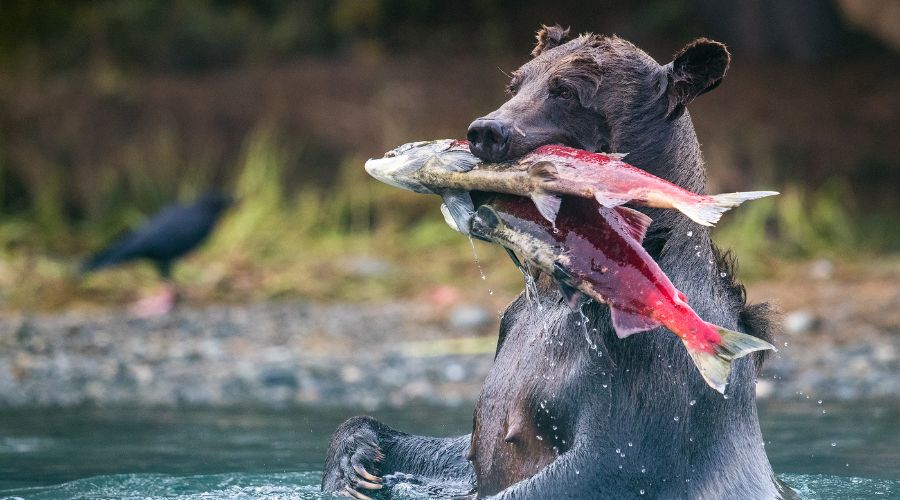
From this review of 75 reports and papers, we discovered that all roads lead back to the water, but more specifically in this instance, one special kind of fish: salmon.
The fate of many species is tied directly to these important fish that connect ocean, freshwater, and terrestrial ecosystems, and that includes Canada’s grizzly bears.
The ecosystem services these fish provide cannot be overstated. When salmon spawn, they return to rivers and streams, providing an important seasonal food source for bears. Bears, in turn, transport salmon and marine-derived nutrients away from waterways and into surrounding terrestrial ecosystems.
Our review also identified an important research question that we believe warrants more attention: How are we addressing changes in salmon availability when connected to our understanding of grizzly bear health and long-term population recovery?
Understanding this connection is key to solving for the cause and not simply addressing the consequence of decline.
Yes, population monitoring can tell us whether bears are present in a landscape and, when repeated over time, help us understand population trends, but population monitoring is expensive, and quantity alone does not give us insight into the condition of individual bears or the ecosystems supporting them.
Food availability directly influences nutrition and body condition, which in turn impacts reproduction and survival. Understanding those relationships, and how they change over time, is fundamental in helping us move beyond the basic question of “how many bears are on the landscape?” and toward more edifying questions such as “are bears, and the ecosystems they depend upon, healthy enough to persist over the long term?”
This is a question we examine in depth as part of our upcoming report on the state of grizzly bear recovery.
"Clean-cut" is a term rarely used in conservation, and for good reason. When dealing with ecosystems, the identification of a single factor does not a case make.
Ecosystems are complex networks where a change in one factor triggers a domino effect across many others.
To truly understand or build a case for an environmental issue such as grizzly bear recovery, we must take a whole-system approach. This means looking at the feedback loops and interconnected factors, along with consideration of the cumulative impacts, such as how the least available resource restricts the growth of the whole system.
A bear moving through a landscape can encounter roads, communities, recreation, resource development, and changing food availability all within a single season. Assessing each pressure independently does not address the bigger picture.
We must do more than isolate a single variable, such as quantity, and claim this as the whole story.
In short, habitat quality, corridor connectivity, human access, food resources, conflict prevention, and human-caused mortality are all interconnected factors that matter and should be considered holistically. The same can be said for stewardship, Indigenous-led conservation, and community participation.
We have decades of grizzly bear research in Western Canada. We have increasingly sophisticated monitoring tools, with more being developed as we speak, and we have a growing evidence base for approaches that reduce conflict.
But research is only as good as the action it informs and how that translates to protecting wildlife on the ground.
That means asking whether recovery plans are being implemented, whether interventions are being evaluated, whether monitoring captures the indicators that matter, and whether decisions affecting habitat are considerate of the broader ecological relationships that sustain wildlife populations.
This is where you come in.
The value of paying attention to the bigger picture cannot be overstated. We must address the interconnected factors that give wildlife populations a chance to sustain themselves in the face of climate change. And we must speak up for habitats and ecosystems that face unnecessary decimation in the name of economic progress, because whether we like it or not, wildlife recovery cannot be separated from the ecological systems that make recovery possible.
Right now, we’re asking you to provide public comment on a proposal that will have lasting and serious consequences for the ecosystems it touches.
Raincoast Conservation Foundation has raised serious concerns about the impact a proposed West Coast Oil Pipeline and tanker terminal at Roberts Bank in the Fraser River Estuary will have on salmon.
According to Raincoast, the federal government is considering designating the proposal a Project of National Interest, and the public-comment period on that designation is open until September 18, 2026.
Decisions affecting salmon reach far beyond the water, and understanding those connections is essential if we're serious about conserving wildlife for generations to come.
Together, we can address the causes of wildlife decline before they result in irreversible consequences. Contact your MP/MLA and provide public comment on this federal proposal. Let the government know that this issue matters to you.
Learn more about the current Fraser Estuary proposal and public comment process: Read Raincoast's analysis and action information. The public-comment deadline is September 18, 2026.
EWC is currently completing a review of grizzly bear recovery and coexistence in British Columbia and Alberta. The forthcoming reports will examine what we know, where important research and implementation gaps remain, and what those gaps may tell us about the future of grizzly bear conservation. If you would like to support this work, please consider making a donation, no matter how small; every dollar makes a difference.
