


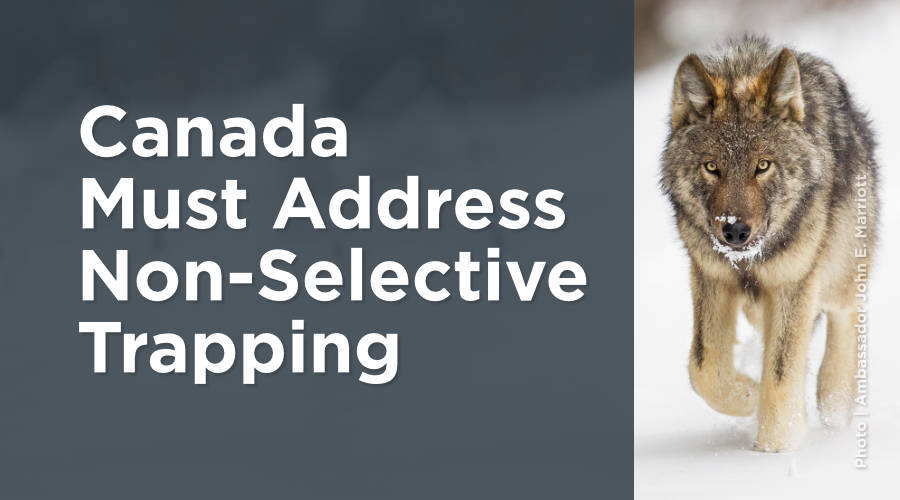
Commercial and recreational trapping has real implications for biodiversity, species-at-risk recovery, and ecological integrity, and the federal government needs to hear that clearly.
The federal government is currently seeking public feedback on its draft 2026–2029 Federal Sustainable Development Strategy (FSDS), a national plan that helps guide Canada’s environmental and sustainability priorities over the coming years.
At first glance, a federal sustainable development strategy may not seem like a place where trapping would come up. But when you look more closely, the connection becomes clear.
The draft FSDS includes commitments related to:
Those commitments matter when it comes to commercial and recreational trapping.
Some trapping practices are non-selective, meaning they do not only affect the intended species. They can also impact non-target wildlife, domestic animals, and species at risk.
Federal wildlife documents, specifically surrounding wolverines and wolves, along with recent scientific literature, already show that trapping can have serious implications for biodiversity and wildlife recovery. If Canada is serious about protecting ecosystems, supporting species-at-risk recovery, and maintaining ecological integrity, then it must also be willing to examine whether the wildlife management standards it continues to rely on are aligned with those goals.
That includes looking closely at the Agreement on International Humane Trapping Standards (AIHTS), a federal international agreement that Canada continues to rely on, and one that has been criticized in scientific literature for significant gaps in how it addresses non-target impacts and certain trapping devices, including the killing neck snare.
We recently submitted comments to the federal government as part of this consultation.
In our response, we raised concerns that the draft FSDS does not clearly address the biodiversity implications of non-selective trapping practices, particularly where they may affect:
We also highlighted that federal recovery and management documents already identify trapping-related threats for species such as wolverine and the Eastern Wolf, and that this issue deserves clearer recognition within Canada’s sustainability framework.
This consultation is one of the ways the federal government hears directly from the public before finalizing the Strategy.
If you care about:
The federal government has created an online form where members of the public can share comments on the draft FSDS.
You can submit comments here:
You do not need to write a long policy submission. Even a short, thoughtful response can help show that Canadians expect biodiversity policy to include real attention to the impacts of non-selective trapping.
If you are looking for ideas, you may wish to comment on:
This is one piece of a much larger effort to ensure trapping policy reflects modern science, public expectations, and the realities of biodiversity protection.
We’re grateful for every supporter who continues to follow this work, share it, and speak up.
If you’d like to support our advocacy and research, please consider making a donation today. Your support helps us continue pushing for stronger protections for wildlife, pets, and the public.
