


There’s something jarring about watching Alberta’s leadership court foreign trophy hunters while many of its own people look for paths out of economic precarity.
As debates swirl around tariffs, industrial policy, and economic sovereignty, it’s hard to ignore the all too familiar pattern of short-term profit framed as progress. We are watching as the long-term health of Alberta’s communities and ecosystems continues to fall by the wayside.
Perhaps it is time we start asking our representatives: what, and who, is this economy really working for? How do we conceive of economic resilience, who gets left behind, and how will today’s youth judge our choices in ten years’ time?
For decades, Alberta’s prosperity has been tied to industries that dig, drill, and deplete. These sectors are politically comfortable, familiar, and well-financed. But comfort has proven to be costly, especially to our ecosystems and the health of our communities.
A resource-dependent economy is an unstable one. It expands rapidly in boom years and collapses just as fast in busts. Meanwhile, biodiversity is lost, communities are hollowed out, and local economies become tethered to forces beyond their control.
As the province continues to cast extractive industries as the path forward toward economic health, it’s increasingly evident that nonprofit, conservation, and ecotourism sectors deliver broader and more inclusive value. Value that is often shared equitably with communities
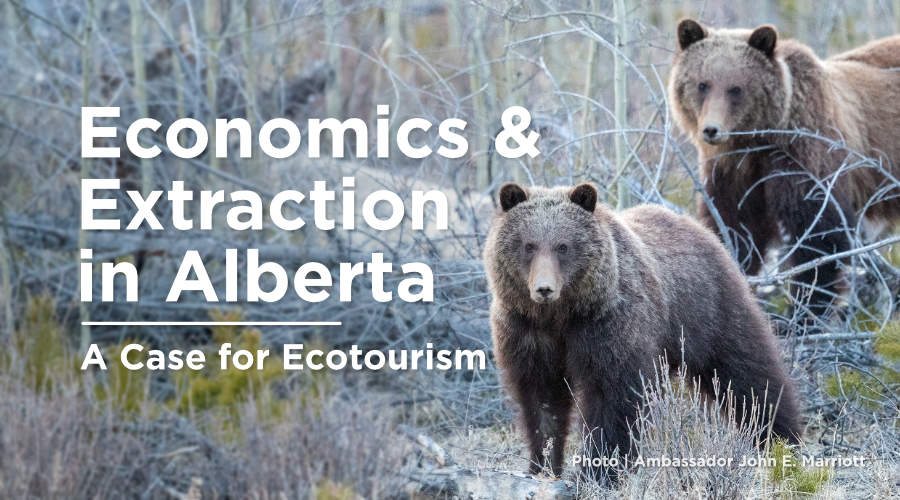
The economic argument for ecotourism is not an abstract one. It has already been tested and measured. A 2014 study by the Center for Responsible Travel (CREST) compared the economic impact of bear viewing and bear hunting in British Columbia’s Great Bear Rainforest. The findings were conclusive: bear viewing generates far greater economic benefit than trophy hunting.
In 2012, bear viewing in the Great Bear Rainforest generated roughly $15.1 million in visitor spending, compared to $1.2 million from bear hunting. The difference in jobs was equally stark. Bear viewing supported over 500 positions, while hunting supported just 11. The study also found that bear viewing contributed over $7 million in GDP, compared to $660,500 from hunting (that’s both resident and non-resident).
Beyond the numbers, the contrast reveals a deeper truth about economic inclusivity. Ecotourism creates work that is diverse, sustainable, and community-oriented. It supports guides, boat operators, cooks, interpreters, accommodation hosts, and educators. Even hunters have found new roles, using their skillsets to protect wildlife within ecotourism reserves. Comparatively, trophy hunting funnels revenue into a narrow industry and often only benefits a small group of outfitters, invested parties and foreign clients.
If the evidence is undeniably clear, where does Alberta’s resistance stem from? Perhaps the answer lies in habit and influence. Extractive industries remain politically convenient and deeply entrenched. They are predictable, familiar, and heavily financed. Ecotourism, by contrast, requires foresight, collaboration, and a willingness to invest in people and reconciliation rather than corporations.
Yes, ecotourism faces challenges; it’s not a golden ticket, but anything that yields long-term value requires effort. It takes infrastructure, training, and careful management to ensure sustainability, but these are surmountable barriers. The greater risk lies in maintaining an economic model that sacrifices biodiversity and local opportunity for the illusion of short-term gain.
The choice between extraction and stewardship is also a choice between centralized wealth and distributed resilience that empowers communities. It’s going to take our communities speaking up and holding the province accountable to avoid repeating history. Alberta’s long-term prosperity will depend on the courage to move beyond old habits and invest in the people and places that make this province strong. Our voices matter now more than ever.
If the goal is economic strength, the route is clear. Investing in ecotourism and conservation-based industries could diversify the economy, create stable jobs, and rebuild the province’s reputation as a place of innovation rather than exploitation.
Instead of bringing in outsiders to extract value from the land, Alberta could empower its own citizens and communities to lead sustainable ventures that build value at home. Instead of selling the pursuit and trophy killing of wildlife for short-term profit, the province could grow local service economies through ecotourism, conservation, and education.
Nonprofit and conservation sectors are lean, mission-driven, and community-oriented. Supporting them would help strengthen rural economies while preserving the landscapes that define Alberta’s identity. When the environment supports the economy, that value remains local, resilient, and multi-generational.
Young people will remember which path we chose. They are already demanding economic models that respect both the planet and the people who live on it. Investing in ecological integrity makes a region not only more sustainable but also more attractive to new business, research, and talent. These changes would not only strengthen rural economies but also honour the landscapes and cultures that make Alberta unique.
Governments can help drive this transition by shifting permits and incentives toward non-consumptive use, ensuring that revenues are reinvested locally, offering low-interest loans for ecotourism infrastructure, and fostering partnerships between Indigenous governments, nonprofits, and private operators. With the right approach, Alberta could become a leader in community-based economic development rather than a cautionary tale of exploitation.
This is not a call for idealism; there are plenty of real-world success stories to look to. The world is changing, and so are the expectations of generations both old and new. A rural diversification strategy built on living ecosystems offers more room to grow, greater inclusion, and more value to sustain. It requires planning, accountability, and care, but the alternative of continuing to extract and exploit for quick profit will only deepen inequality and ecological loss.
If Alberta truly wants a diverse, resilient economy that can weather the challenges of a changing climate, an unstable global market, and shifting public values, then investing in ecotourism and conservation is the pragmatic choice.
We cannot build a lasting economy on the depletion of finite resources. The landscapes and wildlife that define this province are not renewable, and the people who depend on them deserve more than a boom-and-bust inheritance. Ecotourism offers an alternative, keeping value local, encourages stewardship, and ensures that prosperity is shared rather than concentrated or removed altogether.
The next generation will remember which path we fight for and which path those in power chose.
As our resident Communications and Outreach Director, Sam brings a diverse range of experience and skills. From nature-based therapy and education, to brand strategy and research, her passion for science, creativity and storytelling has allowed Sam to work internationally on both grassroots projects and global campaigns. As a lover of wildlife and wild spaces, Sam has dedicated the past five years to working with conservation non-profits and education organizations across rural BC to inspire advocacy for the Canadian wild.
