


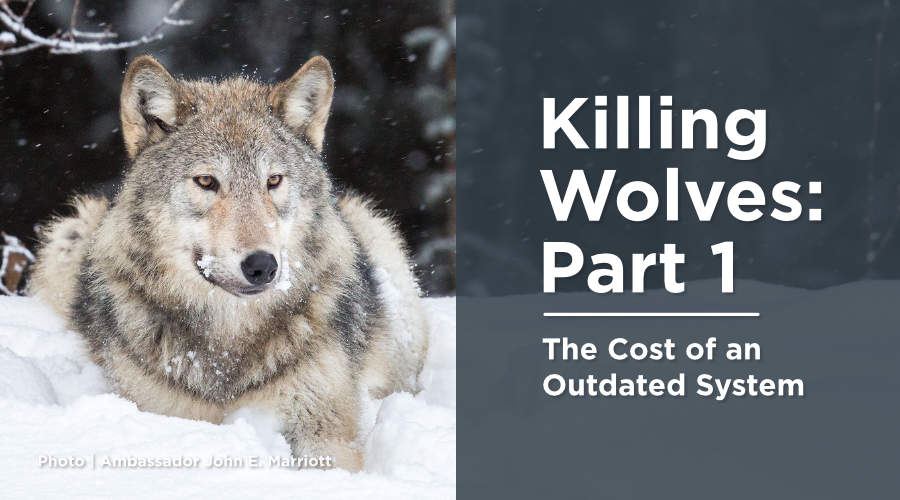
Most of us who live in British Columbia will never actually see a wolf, but still, we are the ones paying for their deaths.
In the past decade, thousands of wolves have been killed in British Columbia through a combination of government-led predator reduction programs and commercial trapping. Much of this killing occurs out of public sight. Programs and policy are framed as technical management rather than political or ethical choices with both financial and far-reaching ecological consequences. Yet the scale, methods, and public cost of these programs deserve far greater scrutiny.
Wolf management decisions are guided by BC’s 2014 Management Plan for the Grey Wolf (Canis lupus). It was established to manage wolf predation on livestock and threatened species, such as mountain caribou, with the government's plan being to systematically kill wolves until their population numbers drop to a level that is just above the threshold of being considered “at-risk”.
Wolf management is often described as complex, but in practice, the province has relied on the same approach for years. The government of BC has positioned lethal control as ‘conservation’; a familiar trope which feels out of step with the investments and progress made by the province in many other areas of wildlife policy.
Over 1,200 wolves are killed annually in BC for recreational purposes, often with no bag limits and long seasons.
Transparency in government policy matters. When harm is hidden from public view, we are less likely to question it, and when costs are spread out or obscured, it is harder to notice or challenge them. This lack of public access to information makes it easier for detrimental practices to continue without accountability.
With awareness comes the power to ask “who benefits, who pays, and what problem, if any, is actually being solved?”
Since 2015, provincial predator reduction programs targeting wolves have resulted in the deaths of more than 2,558 animals in BC. These programs run primarily in regions associated with caribou recovery efforts, costing $1.8 million in taxpayer funds each year. They rely heavily on aerial gunning, a method in which wolves are shot from helicopters with assault-style rifles.
In some regions, government targets aim to reduce wolf populations by up to 80%. That’s as few as three wolves per 1,000 square kilometres, with entire packs being intentionally destroyed.
These targets are among the most aggressive predator reduction thresholds used anywhere in North America.
In the 2025 season alone, 366 wolves were killed across multiple regions. This represents the second-highest annual total since the program began.
Public opposition to the cull is consistent and well-documented. Yet transparency around the program remains limited, with key data only released through repeated access-to-information requests rather than proactive public reporting.
Aerial gunning is controversial for several reasons. Not only does it raise serious animal welfare concerns, but it is expensive to carry out, with these programs costing the public well over $10 million since 2015. At the same time, the science remains consistent and unambiguous; decades of evidence show that killing wolves does not address the primary drivers of caribou decline.
The real drivers are habitat loss, fragmentation, and industrial disturbance.
Despite more than a decade of predator killing, many herds are still in decline. As of 2023, nine of the 17 herds in the Southern Group have either been listed as extirpated (locally extinct) during the cull period or have fewer than 10 animals remaining.
Research consistently finds that predator removal alone fails to produce sustained prey recovery unless habitat is addressed first. Lethal control is known to disrupt pack structure, increasing breeding pairs, juvenile survival and livestock conflict in some areas. Smaller, fractured packs hunt less efficiently, sometimes increasing pressure on alternate prey.
Even the province’s own data shows that wolf numbers rebound quickly after culls due to compensatory breeding, particularly when habitat conditions remain unchanged. This creates a cycle of repeated killing without long-term ecological benefit, while diverting attention and resources away from habitat protection, the single most effective tool for caribou recovery.
GIS mapping analysis shows that 136,229.07 square kilometres of habitat in BC have been lost within caribou herd ranges due to human disturbance.
That is more than twice the size of Nova Scotia.
Looking closely at a system that has become normalized through repetition rather than results, it’s clear to see that the story of wolf management in British Columbia is often framed as a difficult but necessary compromise. Yet when the outcomes are examined closely, that framing feels indefensible.
As Ross Reid of Nerdy About Nature has said, “we’re all just a bunch of wild animals, and we all rely on healthy ecosystems and biodiversity to sustain every aspect of our lives.” That truth invites us to weigh up not only the immediate cost of killing wolves, but the long-term consequences of knowingly degrading the ecosystems that sustain us all.
Predator removal at scale, especially of quintessential keystone species, destabilizes food webs and contributes to habitat degradation. The sanctioned killing of wolves in mass culls is increasing the likelihood of cascading ecological impacts that make landscapes and our homes more vulnerable to climate stress.
If British Columbia is serious about climate adaptation and fiscal responsibility, wildlife policy cannot be treated as separate from climate policy. Mandate letters to the Ministers responsible for climate change and land stewardship explicitly frame biodiversity loss, land-use decisions, and climate adaptation as interconnected challenges to be addressed. Healthy ecosystems not only provide measurable economic benefits, but they are among the most cost-effective tools we have for reducing long-term risk.
Functioning as climate infrastructure, intact predator populations support overall ecosystem resilience, regulating carbon storage, water cycles, vegetation health, and landscape stability. When these systems are disrupted, the costs do not disappear; they just re-emerge elsewhere, often as increased spending on disaster response, infrastructure repair, and emergency adaptation.
Recent economic analysis on climate adaptation consistently shows that investments in ecosystem protection and restoration deliver some of the highest returns of any climate strategy. Non-lethal alternatives, such as habitat protection, restoration, and coexistence strategies, consistently continue to deliver broader and more durable economic returns. They reduce conflict, support biodiversity, and align with sectors that contribute positively to local economies, including conservation, tourism, and Indigenous-led stewardship.
Ultimately, public funds reflect public priorities. How they are spent shapes not only wildlife outcomes, but the long-term health and economic resilience of the landscapes we all depend on. We must pause to ask what is lost when public money is directed toward outdated practices that erode ecosystems and away from approaches that strengthen them.
Understanding the full picture is the first step toward achieving meaningful accountability.
British Columbia already has policy tools in place that support more effective wildlife stewardship. The issue is not a lack of alternatives. Protected area expansion, species-at-risk frameworks, habitat protections, and coexistence initiatives are already part of BC’s wildlife policy toolkit. They simply have not been applied to wolves.
Public policy should reflect public expectations. If British Columbians expect decisions grounded in evidence, transparency, and long-term stewardship, then it is reasonable to ask why a system that repeatedly fails to deliver its stated outcomes continues to receive public funding and political support.
If you expect better, we invite you to stay engaged and take action.
The most impactful way you can make a difference for wolves all over BC is by contacting your MLA and government ministers directly. It’s only through hearing from their constituents that they are able to learn what truly matters to us. Letters, emails and calls provide them with an opportunity to understand the issues and provide representatives with opportunities to amplify our voices.
Live on February 12th, in Part Two of Killing Wolves, we examine the other sanctioned pathways through which wolves are killed in British Columbia, including killing contests and commercial trapping, and how outdated regulations increasingly put wildlife, companion animals, and the public at risk.
Understanding the full scope of this system is essential to changing it.
To the Honourable (MLA’s name),
I am writing to ask that you oppose the continued use of lethal wolf control as a default wildlife management strategy in British Columbia, and to call for an end to provincial policies that prioritize killing wolves over addressing the root causes of ecological decline.
British Columbia has spent more than a decade relying on predator reduction programs that have resulted in the deaths of thousands of wolves, primarily under the justification of caribou recovery. Yet the evidence is clear. Lethal wolf control has not delivered long-term recovery outcomes, while habitat loss, fragmentation, and industrial disturbance remain largely unaddressed.
Wolves play a vital role in maintaining healthy ecosystems. Removing them at scale disrupts food webs, destabilizes landscapes, and undermines the resilience of ecosystems that communities depend on, especially as climate impacts intensify. Continuing to fund repeated culls diverts public resources away from habitat protection, restoration, and coexistence strategies that are proven to deliver lasting ecological and economic benefits.
British Columbia has already demonstrated leadership in other areas of wildlife policy, including species-at-risk frameworks, protected area expansion, and non-lethal coexistence initiatives. These tools exist. The issue is not a lack of alternatives, but the continued reliance on outdated approaches when better options are available.
As a constituent, I expect wildlife policy to reflect current science, fiscal responsibility, transparency, and long-term stewardship. I urge you, as my representative, to support a shift away from lethal wolf control and toward evidence-based strategies that protect ecosystems, wildlife, and the public interest.
Sincerely,
(Your full name)
(Address for reference)
As our resident Communications and Outreach Director, Sam brings a diverse range of experience and skills. From nature-based therapy and education, to brand strategy and research, her passion for science, creativity and storytelling has allowed Sam to work internationally on both grassroots projects and global campaigns. As a lover of wildlife and wild spaces, Sam has dedicated the past five years to working with conservation non-profits and education organizations across rural BC to inspire advocacy for the Canadian wild.
