


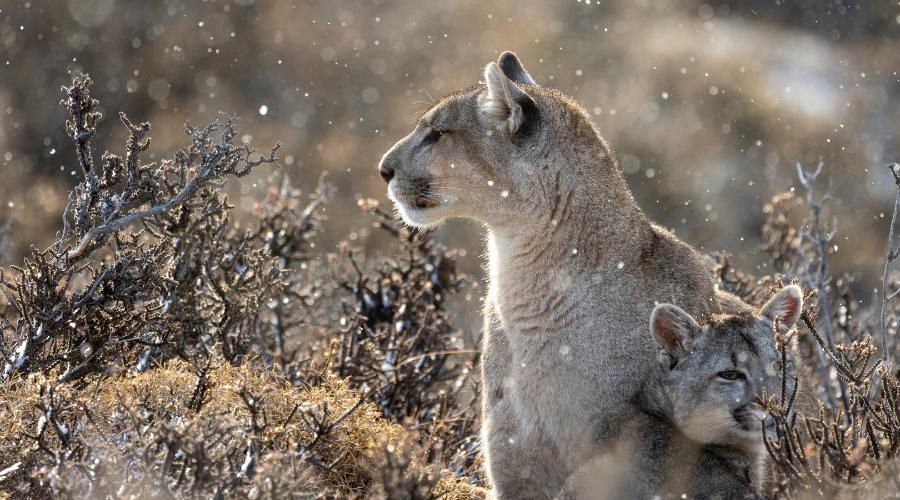
Cougars live alongside communities across western Canada, often without ever being seen. There’s no doubt that these animals are capable of sharing the landscape, but perhaps we should ask the question: How prepared are we humans to live alongside them?
In 2026, Exposed Wildlife Conservancy (EWC) commissioned the Angus Reid Group to survey 1,506 residents of British Columbia and Alberta about their knowledge, experiences, and attitudes toward four apex predators and keystone species: grizzly bears, black bears, wolves, and cougars.
Let’s start with some good news and perhaps the most important finding: our research shows that people overwhelmingly believe coexistence with apex predators is not only necessary but that it is achievable.
In short, people want coexistence to work, and they are willing to make it happen.
Seventy-five percent of respondents agreed that humans and cougars can safely coexist, and 75% were confident that conflicts can be resolved without killing the animal. More broadly, 79% of respondents said they would be likely to change their behaviour when spending time in apex-predator regions if they had clear guidance on how to do so.
But when it comes to cougars specifically, there is a gap between support for coexistence and knowing how to put it into practice.
Just 37% of respondents correctly identified how to respond to a cougar encounter, and only 12% said they would feel calm if they encountered one in the wild. Cougars were also the least commonly encountered of the four apex predators included in the survey.
Alongside the public-perception survey, EWC reviewed more than 75 studies and reports that examine the tools used to reduce conflict between people and large carnivores.
This research revealed yet another important gap: relatively few studies identified through our review evaluated cougar coexistence interventions or conflict in Western Canadian contexts. Essentially, we need more location-specific science to aid our understanding of this keystone species and how best to successfully share our landscapes.
The existing research does, however, reinforce an important lesson: there is no single solution to conflict.
Different tools prove effective in different circumstances. Proactive livestock-management approaches show promise in some settings, and translocation has produced mixed outcomes, but research from British Columbia and the United States has raised questions about relying on increased cougar harvest as a strategy for reducing conflict.
Coexistence, in other words, is a toolkit, and sharing landscapes with apex predators requires the right tools for the job.
People are actively looking for information, and they are willing to adapt their behaviour with the right guidance.
Our research suggests that the next step is to turn awareness into action by providing communities with the relevant knowledge and practical tools to safely coexist with apex predators in our shared landscapes.
It’s also critical that we continue to gather the evidence needed to understand which interventions work, where they work, and under what circumstances.
We invite you to know your neighbour:
Explore EWC's new Know Your Neighbour: What Canadians Told Us About Living With Cougars report, along with our full Living With the Wild public-perception research and Coexistence Tools & Stewardship Effectiveness Report to learn more about what Canadians told us and where the research tells us we need to go next.
