


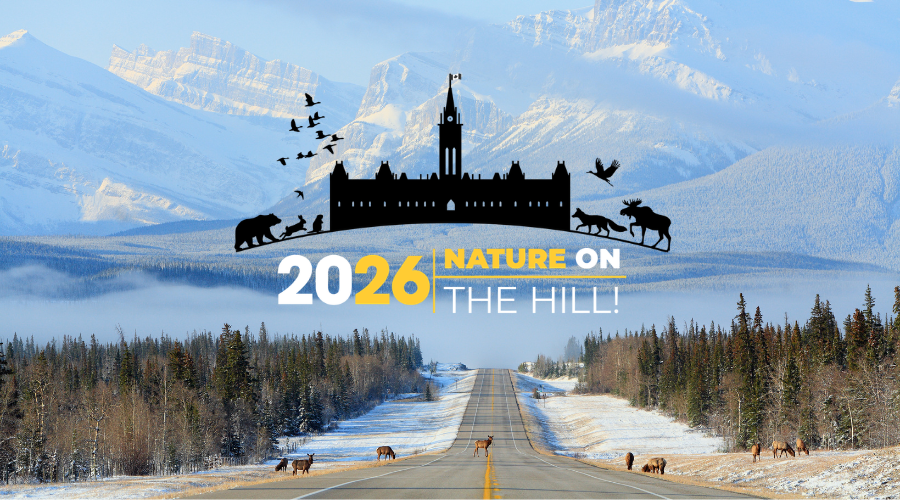
Next week, we'll be in Ottawa for Nature on the Hill 2026, joining Nature Canada and conservation organizations from across the country to bring a unified message to federal decision-makers:
A Canada worth building puts nature up front.
From October 19–21, nature organizations will meet with Members of Parliament, Senators, Ministers, and senior officials to advocate for the implementation of Canada's 2030 Nature Strategy and for nature to remain at the centre of decisions about Canada's future.
This year, our collective message is simple:
Nature is not red tape.
Build major projects better with the mitigation hierarchy.
Nature builds our economy.
Environmental safeguards are not arbitrary barriers to getting things done. They are guardrails, designed to protect ecosystems, communities, human health, and species before damage occurs. And some damage cannot simply be undone. That is why one of the central messages we will bring to Ottawa is the importance of the mitigation hierarchy: first avoid harm, then minimize unavoidable impacts, restore what can be restored, and only consider compensation for remaining impacts as a last resort. It is much easier, and often far less expensive, to protect functioning habitat and wildlife movement before they are lost than to try to recreate them afterward.
Bears, wolves, cougars, and other large carnivores depend on connected landscapes. They don't experience habitat according to jurisdictional boundaries, municipal borders, or project footprints. They need space to move, find food, reproduce, disperse, and maintain healthy populations. And healthy landscapes depend on wildlife too.
Large carnivores play important ecological roles within the ecosystems they inhabit. Protecting them isn't only about protecting individual animals. It is about maintaining the relationships among predators, prey, habitat, and the broader biodiversity of a landscape. When we treat wildlife habitat as an obstacle to development rather than part of the landscape we are responsible for managing, we risk losing ecological functions that are extremely difficult, and sometimes impossible, to restore.
Canada has already committed to halting and reversing biodiversity loss through its 2030 Nature Strategy. Nature on the Hill is about asking government to follow through. Nature Canada's 2026 message is not that economic development must stop. It is that economic and environmental policy need to work together: strong environmental safeguards create certainty, major projects should avoid unnecessary harm from the beginning, and Canada's natural capital is itself an important part of our economy.
There is also remarkably broad common ground when it comes to wildlife and habitat. Canadians value nature. Nature Canada's polling cited in the Nature on the Hill materials found that 75% of Canadians believe safeguarding Canada's natural heritage should be a key consideration when building the country.
Over the past year, we have been building the evidence behind our own work. We've examined research on human-wildlife coexistence, studied public attitudes toward apex predators, looked closely at wildlife-management policy, and continued working on issues affecting bears, wolves, and cougars across Alberta and British Columbia.
Nature on the Hill gives us an opportunity to bring what we are learning into a much larger national conversation. We aren't going to Ottawa with a separate EWC agenda. We are going as part of a national network asking Canada to honour the commitments it has already made to nature, and to recognize that protecting biodiversity and building a strong country are not competing objectives.
Wildlife needs to be considered before habitat is fragmented, before conflict escalates, and before populations are placed at greater risk.
Because once some things are gone, there is no mitigation measure that can truly put them back.
