


FOR IMMEDIATE RELEASE
November 27, 2025
EWC Responds to Federal Agreement and Minister Resignation
British Columbia — Exposed Wildlife Conservancy (EWC) is expressing deep concern following today’s Memorandum of Understanding (MOU) between Prime Minister Mark Carney and Alberta Premier Danielle Smith to pursue a crude oil pipeline to the Pacific Coast. The announcement includes plans to revise the longstanding oil tanker protections on parts of British Columbia’s coast if the pipeline proceeds.
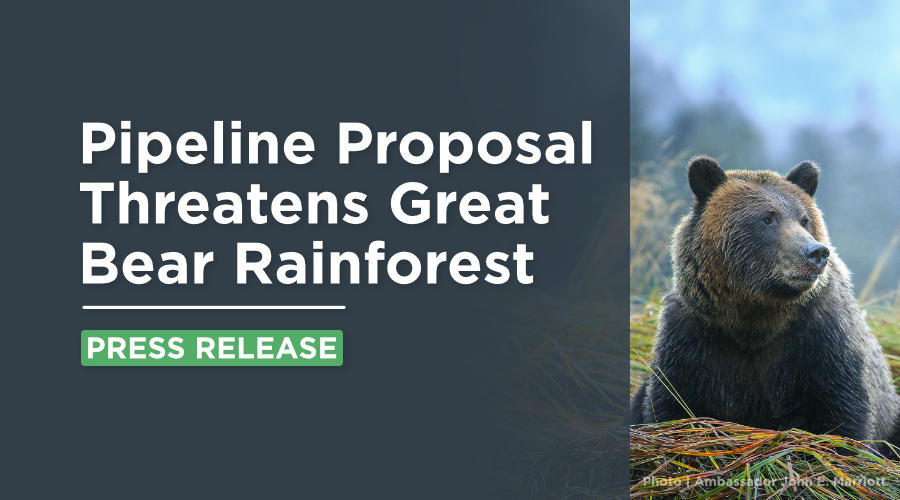
The proposed project would cross or border the Great Bear Rainforest, one of the most ecologically significant temperate rainforests on Earth and the foundation of coastal First Nations culture, food security, and governance. This region is home to grizzly bears, wolves, coastal sea wolves, and the globally unique Kermode bear. Grizzly bears (Ursus arctos) remain Blue listed in BC as a Species of Special Concern.
The pipeline announcement has already resulted in the resignation of federal cabinet minister Steven Guilbeault, who left his post in protest. In his resignation statement, he cited strong opposition to the agreement and warned that the project risks undermining Canada’s climate commitments and rolling back years of environmental progress. Guilbeault noted that the proposed route could cut through the Great Bear Rainforest. Any project that increases tanker traffic through this coastline raises the risk of catastrophic spills that cannot be cleaned up in these remote, delicate marine ecosystems.
Exposed Wildlife Conservancy shares these concerns.
EWC recognizes the economic pressures Canada is facing, including shifting trade relationships and market instability. However, sacrificing one of the most irreplaceable ecosystems in the country is not a path to long-term prosperity.
“Projects that cross the Great Bear Rainforest and threaten coastal waters should never be treated as negotiable. No economic argument outweighs the ecological and cultural significance of this place,” says Maggie Spizzirri, Executive Director of Exposed Wildlife Conservancy.
Coastal First Nations leaders have made their opposition clear. Heiltsuk Nation Chief, Marilyn Slett, stated that the project has no support, no company, and no funding, and that the Nations have zero interest in co-ownership or economic benefits from a project that threatens their way of life. British Columbia Premier David Eby echoed this, noting that lifting the tanker ban would jeopardize existing projects and long-standing agreements with coastal Nations.
"We've been very clear that the Coastal First Nations, the Haida Nation, the people of the coast, will never allow oil tankers or this pipeline in our territory because of the risks to our culture, our way of life and our self-sufficiency," said Jason Alsop, president of the Council of Haida Nation and vice-president of the Great Bear Initiative, an alliance of Coastal First Nations
"The ocean is what looks after us, and we have a responsibility to uphold that."
The Great Bear Rainforest is a globally significant conservation achievement built through decades of leadership by First Nations, conservation organizations, and communities. It is a place where salmon nurseries sustain entire ecosystems, where grizzly bears still follow ancient food routes, and where coastal Nations have stewarded their territories since time immemorial.
Increasing tanker traffic in these waters introduces the risk of diluted bitumen spills in channels where tides, storms, and remoteness make cleanup nearly impossible. The collapse of salmon runs and the loss of keystone species would cascade across forests, wildlife, and coastal food systems. They also form a key part of a thriving conservation economy that brings stable, renewable income to First Nations and coastal communities.
Independent economic studies on the Central Coast have consistently shown that bear viewing generates significantly higher economic returns than extractive industries. Local Nations and businesses have built successful operations that create year-round employment, support community development, and rely on the continued health of grizzly bears, salmon, and intact rainforest habitat. These economic benefits are long-term and renewable, unlike the boom and bust cycles tied to resource extraction.
EWC is calling on the federal government to:
Canada is at a crossroads. Decisions made now will shape ecosystems, communities, and economies for generations. Rolling back environmental protections to advance a project that lacks First Nations support, financial backing, or a committed proponent is neither sound policy nor responsible governance.
“Canada needs economic stability, but that cannot come through projects that compromise the very systems life depends on. Climate, biodiversity, and Indigenous rights must be treated as non-negotiable foundations, not obstacles,” says Spizzirri.
Exposed Wildlife Conservancy is a registered Canadian charitable organization committed to advancing science-based wildlife stewardship and promoting coexistence with large carnivores such as grizzly bears, wolves and cougars across Western Canada. Our work focuses on public education, coexistence programs, community support, and evidence-based policy that protects both human safety and ecological integrity. We collaborate with conservation groups, scientists, educators, and rural communities to strengthen approaches that reduce conflict and support long-term species recovery.
Maggie Spizzirri, Executive Director
Exposed Wildlife Conservancy
mspizzirri@exposedwildlifeconservancy.org
www.exposedwildlifeconservancy.org
@exposdwc
